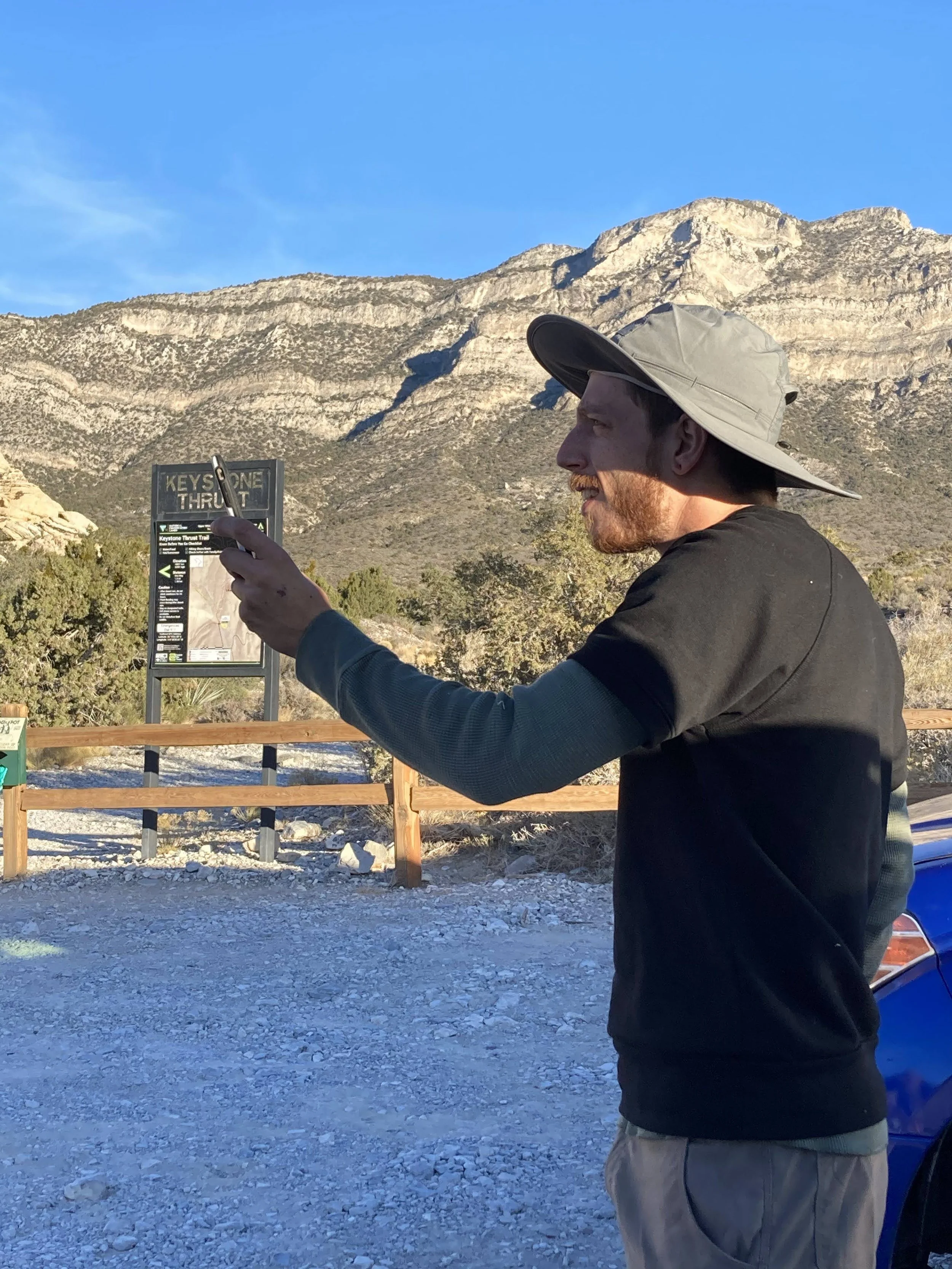
Me, appropriately dressed and very much knowing what I’m looking at.
Climbed a few times, most recently November 7, 2026
Fun Rating: Pretty decent
Have you ever had a dream that you, um, you had, your, you- you could, you’ll do, you- you wants, you, you could do so, you- you’ll do, you could- you, you want, you want them to do you so much you could do anything?
-That one kid from the meme.
I wanted to be a trad climber basically as soon as I learned what trad was. Anyone who’s been reading the blog for awhile will know that I began my climbing career in the gym, in Chicago specifically. That came with pros and cons, as do all things. The pros included a great selection of gyms with tall walls, a lively and welcoming community (some of which remain close friends and partners to this day), and having the CTA to go wherever in the city I needed to get to. The cons, as any Chicago climber who has moved elsewhere will tell you, consist mainly of proximity to outdoor climbing, or the lack thereof. The nearest climbing at all was up in Baraboo, Wisconsin at Devil’s Lake. Cue the mixed cheers and groans depending on what kind of climber you are.
Made up of bullet hard and slick quartzite, Devil’s lake is a gorgeous destination for the kind of mean-spirited climbing that I think really embodies the midwest as a whole. The lake is sandbagged, difficult to climb, and seemingly always out of proper conditions (I worked Axiom of Arete Aesthetics over multiple seasons and never actually found it properly dry). This lends itself to being a place for tough climbers who climb tough things. I’m…not really that guy, as I’m sure you’ve all gleaned by now, and so I eventually gravitated towards Jackson Falls and the Red River Gorge as my preferred destinations for climbing. The savvier climbers among you may note that neither of those places are really known for a thriving trad scene. The even savvier among those, who know Devil’s Lake, know that it is exclusively trad and bouldering, as the local ethic absolutely forbids bolting of any kind. Combine that with the slick and difficult nature of the rock and you end up with a place that is not as beginner-friendly as many other crags when it comes to folks getting their feet wet plugging gear. Needless to say I had a light rack that didn’t get used for awhile while I was living in Chicago for this specific reason.
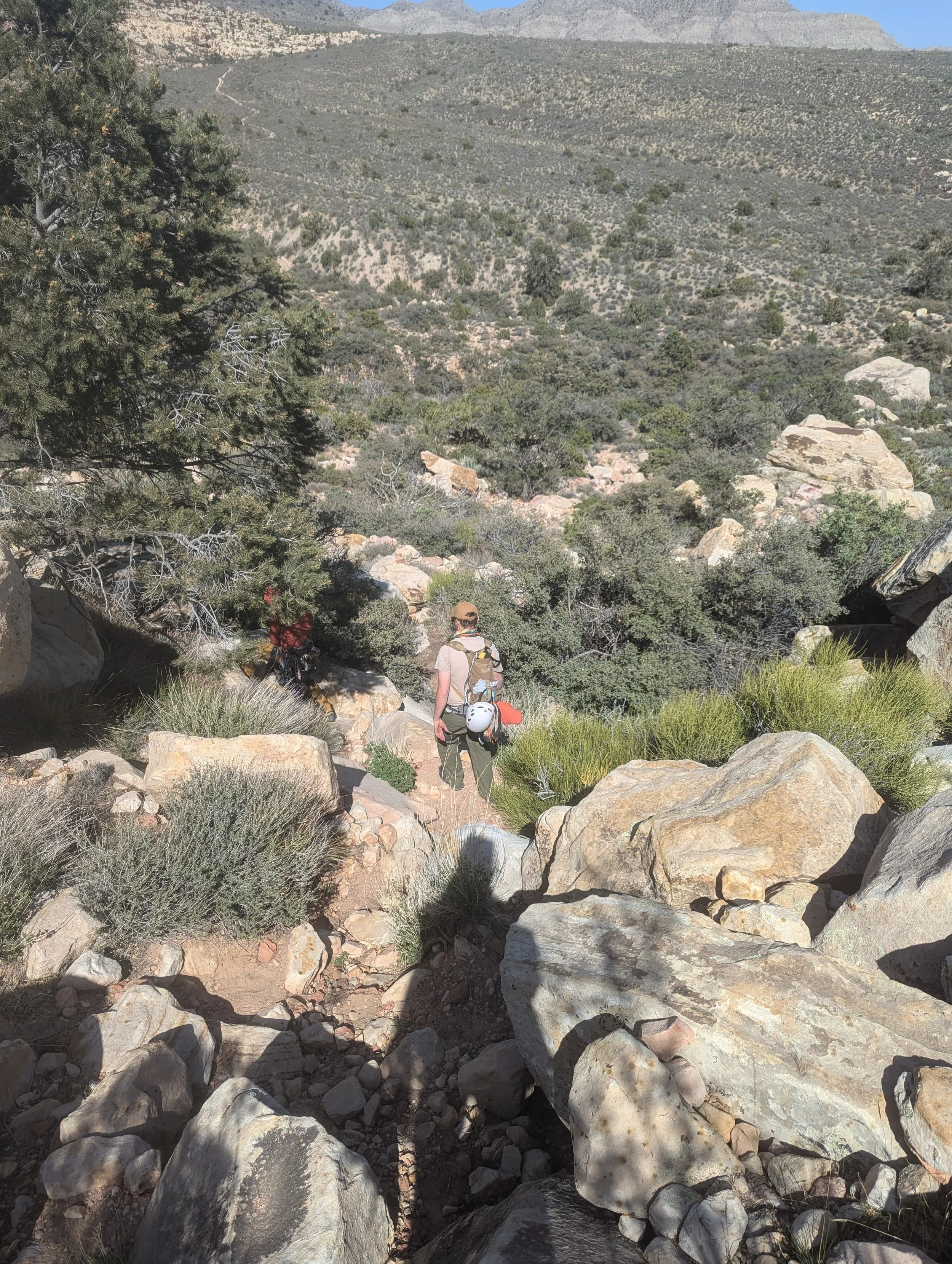
Technically the walkoff, but here’s the hike
And so, Vegas. My wife and I had visited a couple times with friends on climbing trips and quickly fell in love with the climbing in RRC. With more routes than a lifetime of climbing could tick off and a good handful of world class routes of all styles, the fact that it’s a 20 minute drive from the city to get there is only the cherry on top of the delicious sandstone sundae. After a mishap where I tore my hamstring on Monkey Bars (yes the V2) and a brief recovery period where I hobbled from sport crag to sport crag, unable to use my left leg very well, it was time to dive in and start climbing trad. Carson, a friend of ours and our roommate at the time, had been eyeing Group Therapy for awhile and, given my predilection for the wide and weird, figured it’d be a great first big multipitch for us, and a great first multipitch to lead for me. Off we went, to the parking lot and then the trail and then stashing our packs and then the base, where she took off on the first pitch and quickly reached the anchor to bring us up.
I remember looking up at the second pitch with no small amount of trepidation. It looked fun but I had heard the protection was a little iffy. After setting off and wedging myself into the wide crack, I was presented with the fact that the protection was, in fact, quite iffy. Too wide for reasonable gear in the parts of the crack that were solid, the only places you could really place gear were in the cracks formed by a flake system that made up one wall of the wide crack. A light tap sent drum reverberations throughout the flake and instantly told me that, while I could place gear there, any protection inside that flake would certainly not hold a fall. I remember feeling a little gripped as I proceeded along the pitch before, with a mantra of “remember you like this, remember you like this” I made my way to the top of the pitch and set up an anchor.
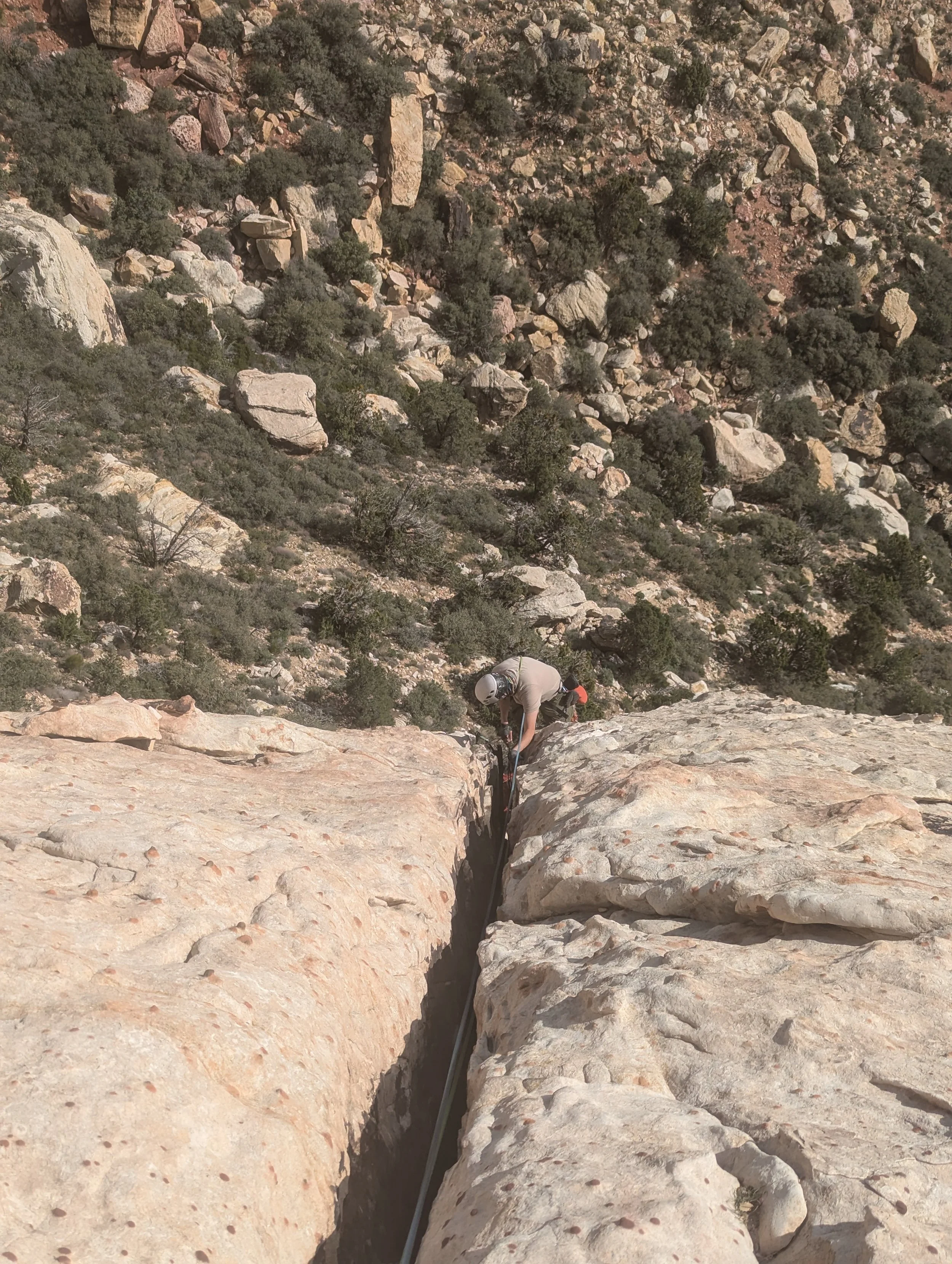
Mike at the top of the second pitch.
The next pitch is mostly forgettable, a traverse left to the base of a wide crack system, then a belay either at the base or at some trees depending on whether you’re linking pitches. I’ve done this a few different ways now, but I personally like setting a belay up here to mitigate rope drag and then jetting straight up to belay near the trees at the base of the chimney system that makes up the 4th or 5th pitch, again depending on whether you’re linking. This was, yet again, my lead and I remember feeling quite intimidated by the chimney the first time I did this route. I recently repeated this with Megan and our friend Pat, and led this through the squeeze chimney itself. I’m glad I did because, after 5 years and hundreds of pitches on gear, the chimney was casual and a blast. Definitely runout, there was a solid 30ish feet where you just can’t place gear, but it’s such trivial climbing and so secure with the chimney behind you that I find it difficult to imagine someone falling in that section.
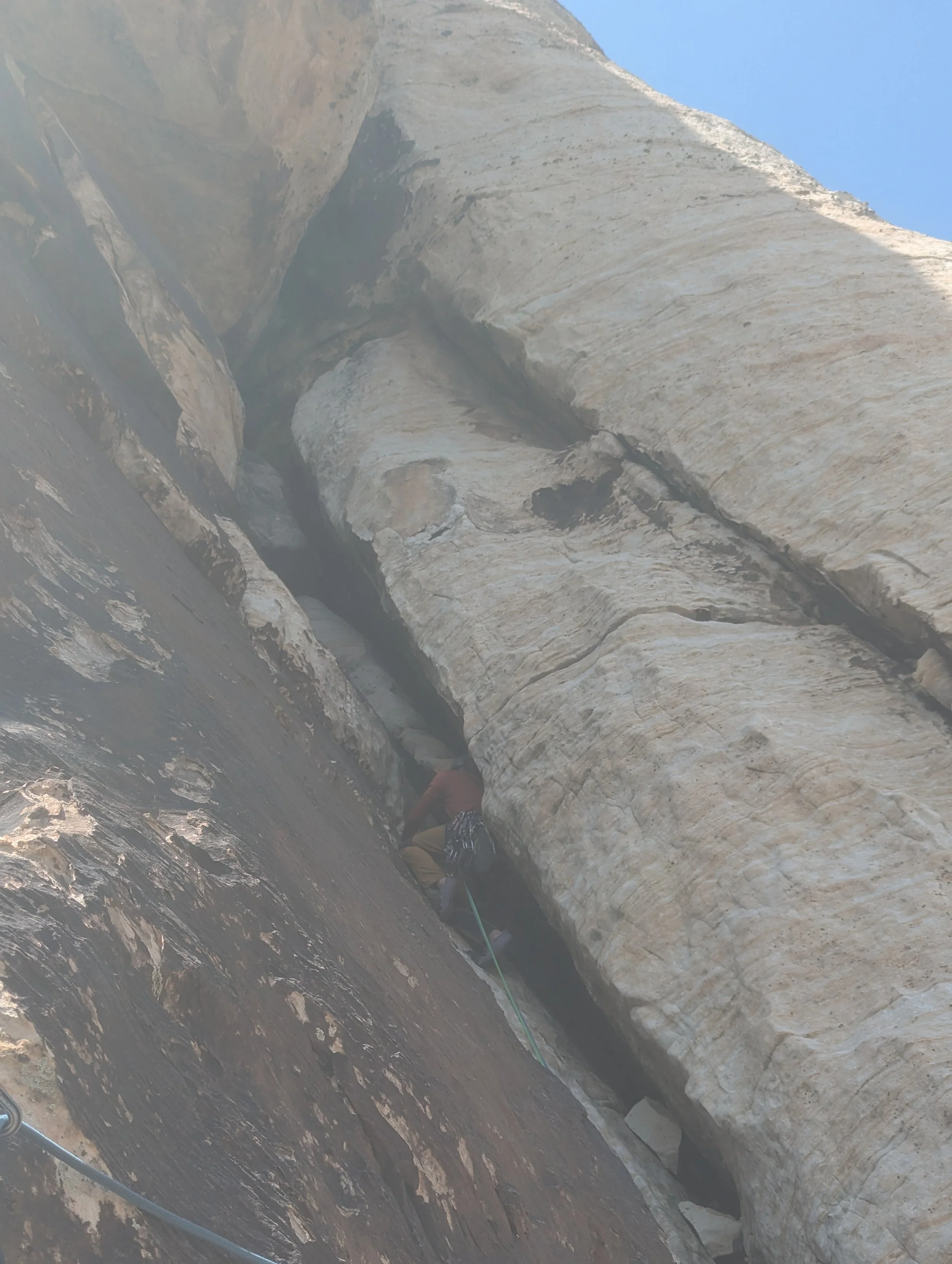
Zak in the chimney
At last we come to the highlight of the route, the roof pitch that is easily visible from the parking lot when looking up at the wall. Huge, intimidating, and seemingly much more difficult than it is, I think this pitch is a perfect example of so much of Red Rock trad. Holds seemingly appear from thin air, feet are just in the right places, and after so many parties climbing it even the thin holds are absolutely bomber. Pulling the roof in the first place gives you instant exposure and then you’re faced with a couple of options. The first, and I think the one most climbers opt for, is using the crimps and balls to mostly face climb next to the crack, protecting occasionally where it’s possible to. The second, and the one I did and find significantly more fun (and more secure) is to just offwidth the damn thing. Between some chicken wings, palm action, and being comfortable in squeeze chimneys, the crux pitch goes very comfortably at the grade. The gear is still spaced out, and in one of my times climbing this route we had some friends following us who weren’t as comfortable in the terrain as I am, so my wife left the gear I’d placed and extended it quite a bit for our friends behind us to clip and feel better. Lucky that the next pitch is 5.4 (and I place approximate 2 pieces of gear on it) so there wasn’t any issue leading it with a light rack.
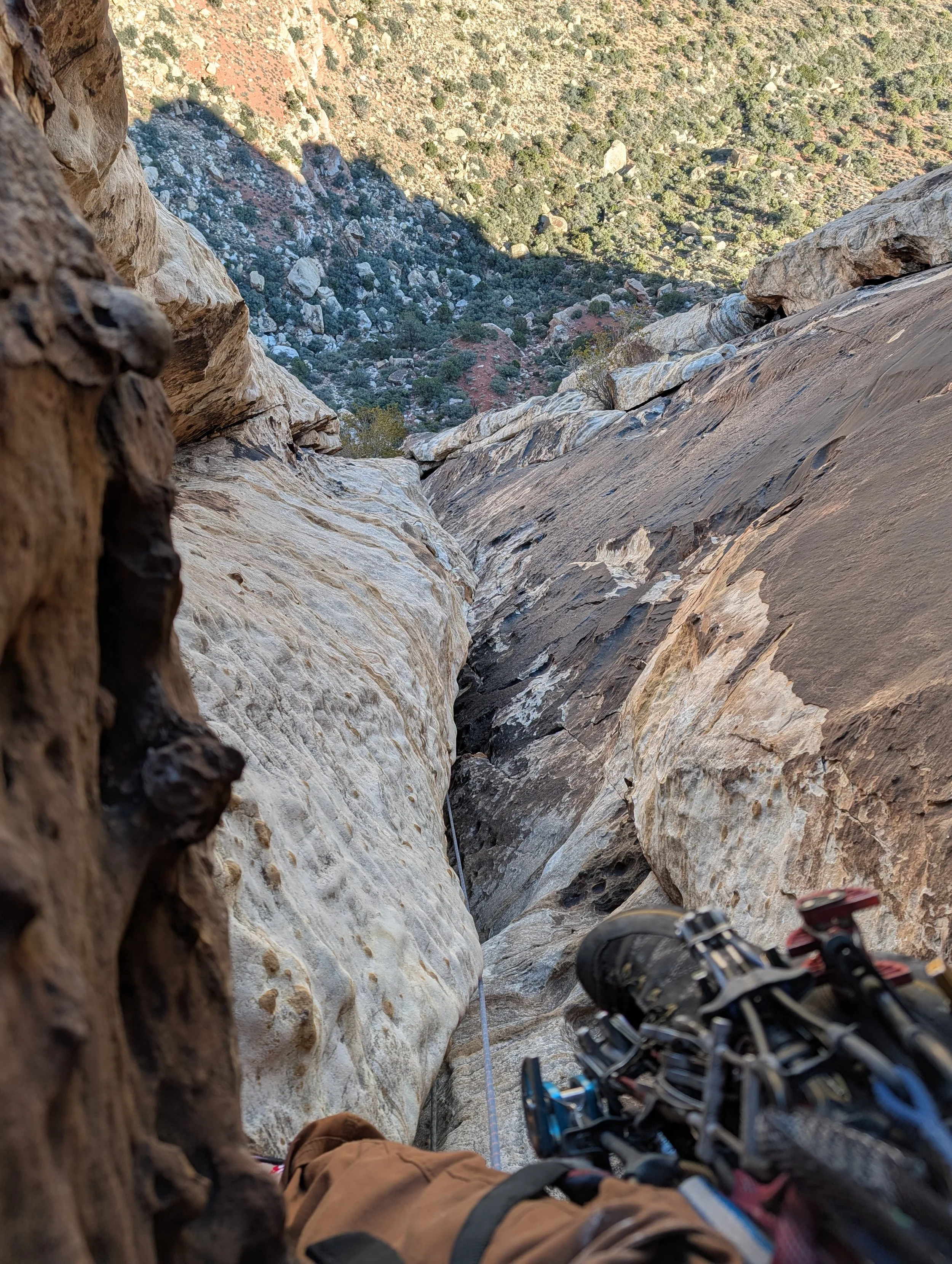
Me in the crux, looking down at the chimney.
I’ve now done this route specifically 3 times, and 2 of those times I was unable to figure out how to make my way into the second gully of the walkoff, the one that doesn’t require a rap. I don’t actually think the one with the slung block truly requires a rap, as you could definitely shimmy down the smooth chimney next to it without too much risk, but for the group we had most recently a 40’ rap definitely seemed like the better option. After the rap you have another 30ish minutes of walking down the gully, with a couple of sections that seem much more scary and intimidating than they end up being. There’s some natural stairs and a fun little slide section that I enjoy. After that you’re back in that absolute junk pink dirt before sidling down the wash to wherever you stash your packs (I’d highly recommend you do so.)
On our most recent climb of this route, my wife remarked that contrary to how she felt the first time, she felt so secure following that she was almost bored. I think that’s a good summation of the route. The grades, as far as I’m concerned, are absolutely dead on in Mountain Project. Any struggle or feeling that things are harder than the grade is likely the result of the runouts on the route creating a feeling of danger, one that I don’t think is unfounded for new leaders or folks breaking into 5.7 multipitch. I find it difficult to imagine how someone would fall in any of these places outside of a hold breaking, but sandstone does do that and as such I fault no one for getting a little stressed in a couple spots on the route.
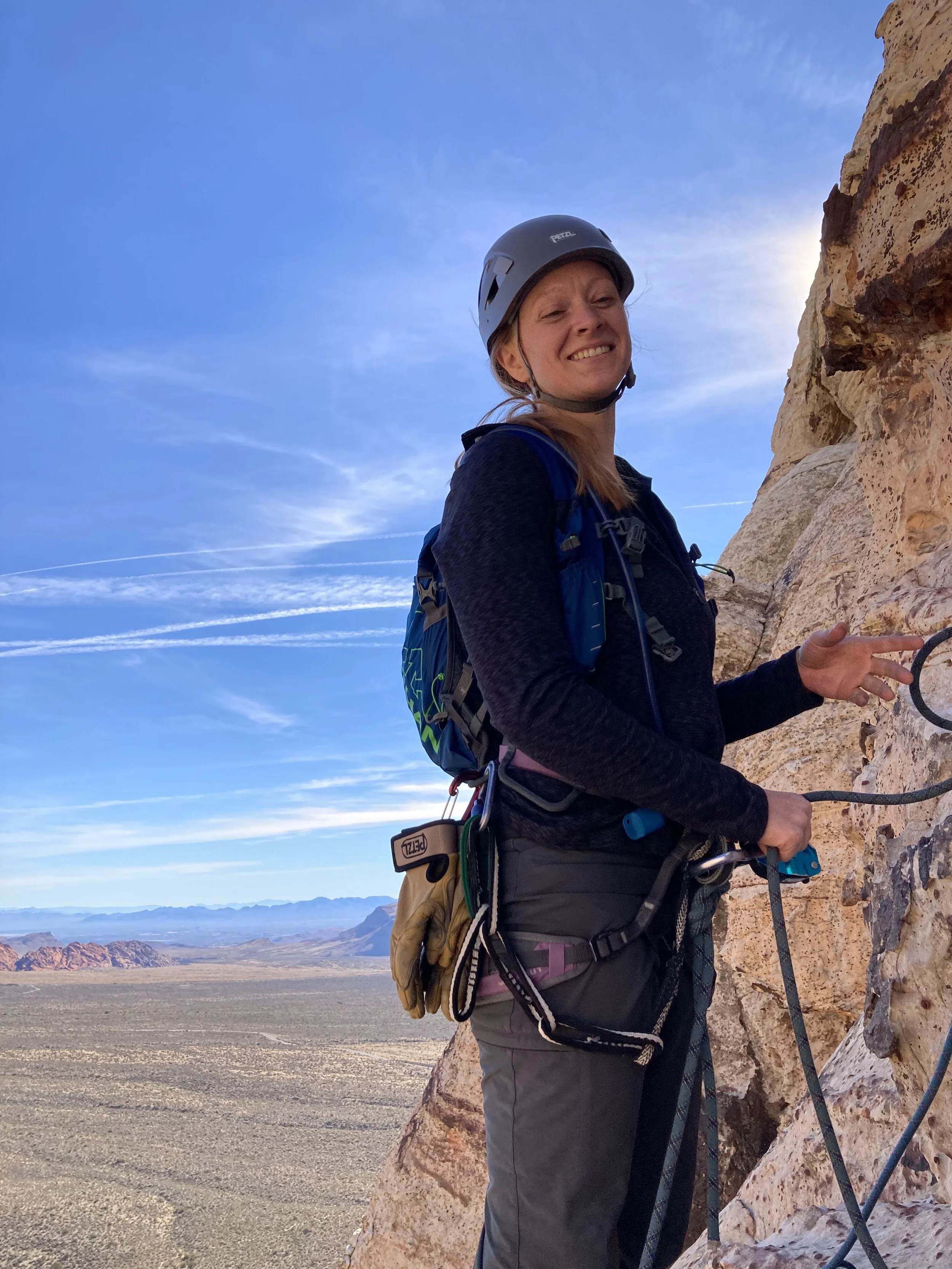
Megan looking great and belaying effectively.
As far as recommendations go, I definitely think people should climb Group Therapy at some point. It’s got some fun sections and the crux is legitimately cool. That said, I don’t think it’s as good as Stilgar’s or Purblind on the same face, and Echolalia is still by a wide margin the coolest route over there (someday people other than Zak and I will climb it and I can’t wait for their comments on the MP page). I think I’d rate it a: “wouldn’t wait in line, but worth doing”/10.
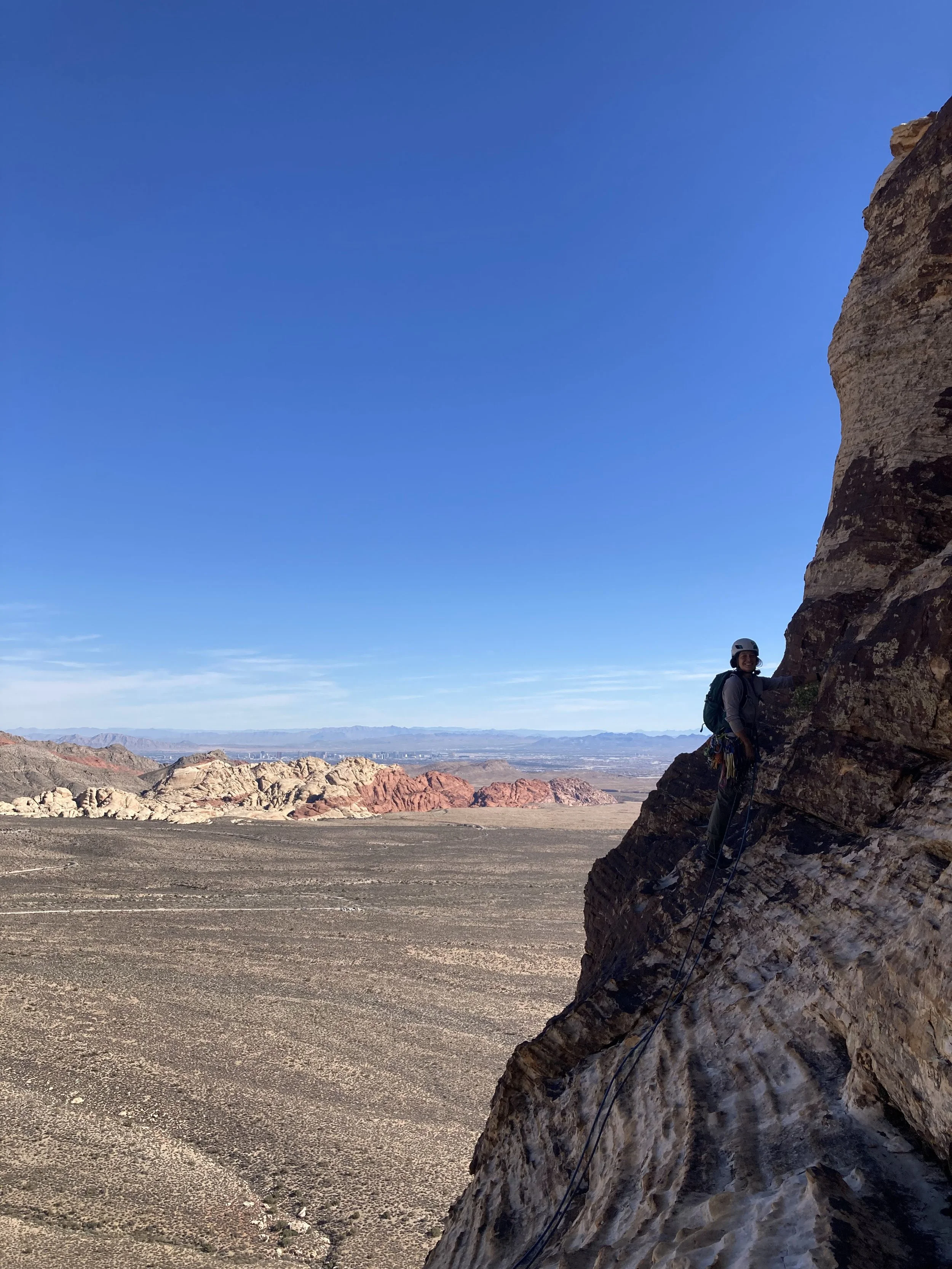
Carson on the traverse pitch.
Gosh, that was a surprisingly dry one, huh? Almost like an actual route report, what’s happened to me? Let me think for a second. Uhhh, oh yeah I started this by talking about how I always wanted to climb trad and now I do so let’s just say this is about…doing the things you want to do? Not letting dreams be dreams? Carpe potestatem? I don’t know man, let’s just say this is about how we should all get out and climb the things we like, have fun or something.
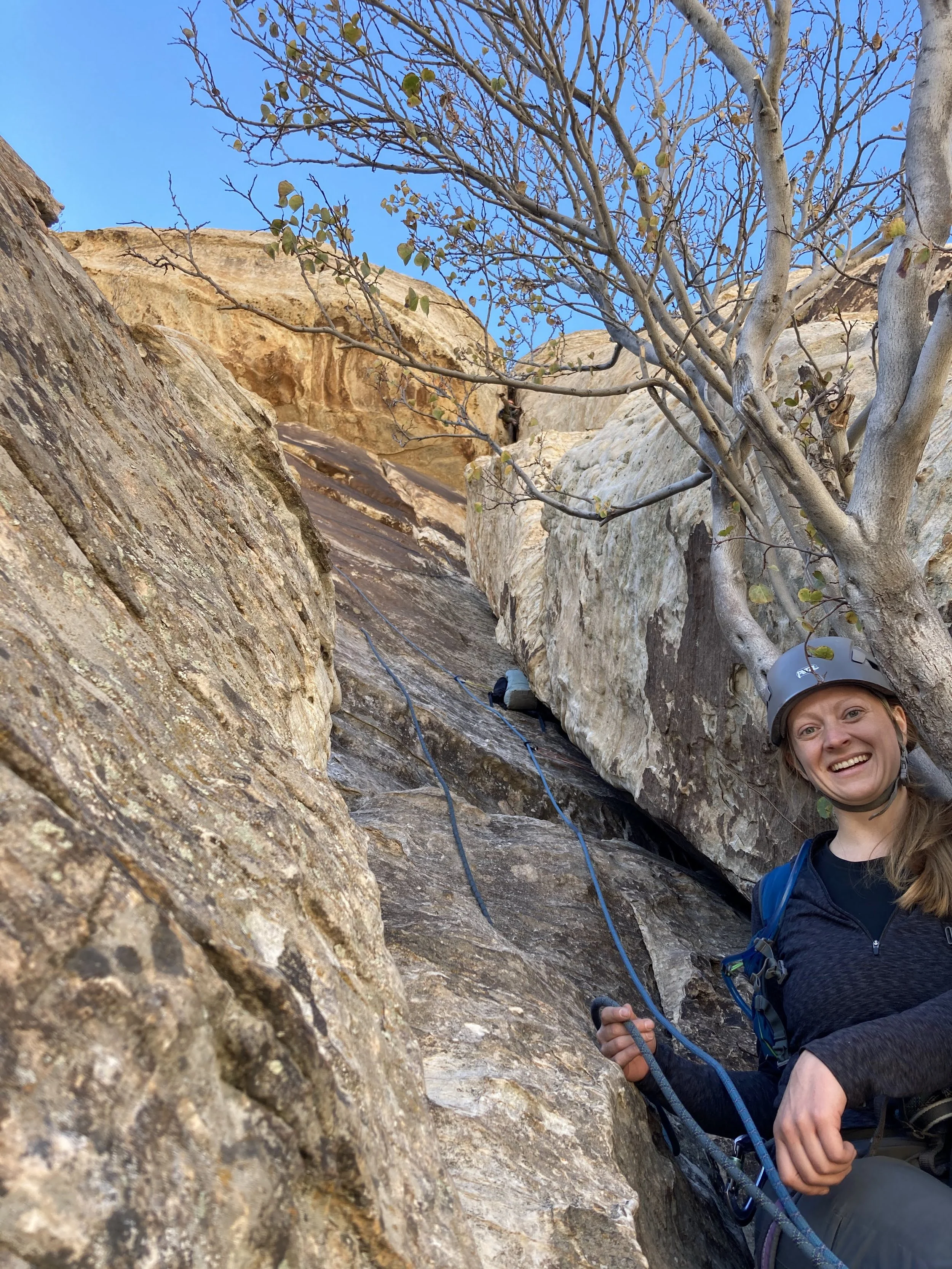
Megan smiling and me wayyyyy up in the roof pitch.
